

Introduction
Industrial facilities release emissions as part of different manufacturing, combustion, processing, and production activities. Regular testing helps businesses understand what is being released and whether emission-control systems are performing as expected.
One of the common questions asked by industrial facility owners is: How often should industrial emissions be tested?
There is no single testing schedule that applies to every industrial facility. Emissions testing frequency depends on several factors, including the type of industry, emission source, pollutants, operating conditions, production capacity, permit requirements, previous test results, and changes to the facility.
For businesses operating in Oman, developing an appropriate emissions testing schedule can help support environmental monitoring, reporting, and compliance activities.
What Is Emissions Testing?
Emissions testing involves measuring or sampling pollutants released from an industrial source.
Testing may be carried out on sources such as:
- Boilers
- Furnaces
- Generators
- Kilns
- Process stacks
- Industrial exhaust systems
- Combustion equipment
- Other emission sources
Depending on the facility, testing may assess pollutants such as:
- Particulate matter
- Nitrogen oxides (NOx)
- Sulphur oxides (SOx)
- Carbon monoxide (CO)
- Carbon dioxide (CO₂)
- Volatile organic compounds (VOCs)
- Other process-specific pollutants
The exact parameters depend on the industrial process and applicable requirements.
Why Is Emissions Testing Frequency Important?
A suitable testing schedule allows businesses to collect environmental data at appropriate intervals.
Supports Environmental Compliance
Industrial facilities may have specific environmental monitoring or reporting requirements.
Following the applicable testing schedule helps businesses maintain the records needed for environmental management.
Identifies Changes in Emissions
Emission levels can change because of:
- Equipment condition
- Fuel changes
- Production levels
- Maintenance
- Process modifications
- Pollution-control performance
Regular testing helps identify these changes.
Supports Equipment Maintenance
Unexpected emission results can provide an indication that equipment or pollution-control systems may need investigation.
Builds Historical Data
Repeated testing creates a history of emission performance.
This makes it easier to compare current results with previous measurements.
Factors That Determine Emissions Testing Frequency
The correct emissions testing frequency depends on the specific facility.
1. Applicable Environmental Requirements
One of the first things a facility should check is whether its environmental approval, permit, monitoring plan, or other applicable requirements specify a testing schedule.
Where a specific frequency is required, the facility should follow that requirement.
Businesses should verify the current requirements applicable to their particular activity rather than relying on a general testing interval.
2. Type of Industrial Activity
Different industries can have different emission profiles.
For example, a facility operating large combustion equipment may have different monitoring requirements from a facility involved in material processing or chemical production.
The type of process should therefore be considered when establishing a testing schedule.
3. Number of Emission Sources
A facility may have one major emission source or several.
Sources may include:
- Main production stacks
- Boilers
- Backup generators
- Furnaces
- Process exhausts
- Dust-generating equipment
Each source may require a different monitoring approach.
4. Type of Pollutants
Different pollutants can require different monitoring and testing methods.
For example, a facility may need to monitor particulate matter while another facility may need to focus on gaseous pollutants or process-specific substances.
The testing schedule should reflect the relevant environmental risks and requirements.
5. Production Capacity
The scale of industrial operations can influence the environmental monitoring requirements.
A facility operating at a larger production capacity may have different emission characteristics from a smaller facility.
Changes in production capacity should therefore be documented and considered when reviewing the monitoring program.
6. Fuel Type
Fuel selection can affect industrial emissions.
Different fuels can produce different emission profiles.
If a facility changes fuel type, it may be appropriate to review the emissions monitoring plan and determine whether additional testing is necessary.
7. Previous Test Results
Historical test results are another important factor.
If results have remained stable over time, a facility may continue following its established monitoring schedule where permitted.
If results show unexpected increases or significant changes, additional investigation or testing may be appropriate.
8. Equipment Condition
Equipment condition can affect emission performance.
Problems with:
- Burners
- Filters
- Scrubbers
- Dust collectors
- Combustion systems
- Exhaust systems
may influence emission levels.
After significant maintenance or equipment modifications, businesses should consider whether additional testing is appropriate.
9. Changes in the Production Process
Changes to production processes can affect emissions.
Examples include:
- New equipment
- Increased production
- New raw materials
- Different fuels
- Process modifications
- Changes in operating conditions
A monitoring program should be reviewed when significant changes occur.
Is Annual Emissions Testing Enough?
Annual testing may be appropriate for some facilities if it meets their applicable requirements and monitoring objectives.
However, it should not be assumed that annual testing is suitable for every industrial facility.
Some operations may require more frequent monitoring, while others may have different schedules.
The correct approach is to determine the required frequency based on the facility’s environmental requirements and specific operating conditions.
Should Emissions Be Tested After Equipment Maintenance?
Testing after significant maintenance can be useful when the maintenance could affect emissions.
For example, work involving:
- Burners
- Filters
- Scrubbers
- Exhaust systems
- Pollution-control equipment
- Combustion systems
may change emission performance.
Follow-up testing can help determine whether the equipment is operating as expected.
Whether testing is required should be determined according to the facility’s monitoring program and applicable requirements.
Should Testing Increase When Emissions Rise?
If test results show an unexpected increase in emissions, the facility should investigate the reason.
Possible causes include:
- Equipment problems
- Fuel changes
- Process changes
- Pollution-control failure
- Maintenance issues
- Unusual operating conditions
- Measurement or sampling issues
Additional testing may be appropriate depending on the situation.
The objective should be to understand the cause rather than simply increasing testing without investigating the underlying problem.
Routine Monitoring vs Emissions Testing
Routine environmental monitoring and formal emissions testing are related but not always the same.
Routine Monitoring
Routine monitoring can involve ongoing observations, measurements, equipment checks, or operational data collection.
Emissions Testing
Emissions testing generally involves a defined testing activity designed to measure selected pollutants from an emission source.
A facility may use both approaches as part of a broader environmental management program.
How to Create an Emissions Testing Schedule
A simple process can help businesses develop a practical monitoring plan.
Step 1: List Emission Sources
Identify all major emission sources within the facility.
Step 2: Identify Relevant Pollutants
Determine which pollutants are associated with each source.
Step 3: Review Applicable Requirements
Check permits, approvals, monitoring plans, standards, and other applicable requirements.
Step 4: Review Historical Results
Look at previous test reports to identify trends or unusual changes.
Step 5: Consider Operational Changes
Record changes to equipment, production, fuel, raw materials, or processes.
Step 6: Establish the Testing Schedule
Set an appropriate schedule based on the information collected.
Step 7: Track Testing Dates
Maintain a calendar or environmental monitoring register.
Step 8: Review Results
Compare new results with previous data and applicable requirements.
Step 9: Investigate Unusual Results
Take appropriate action when significant changes are identified.
Example Emissions Testing Schedule
The following is a general planning example only, not a universal regulatory schedule.
| Situation | Possible Monitoring Approach |
|---|---|
| Stable industrial operation | Follow applicable routine testing schedule |
| New emission source | Establish baseline testing where appropriate |
| Major equipment modification | Review whether additional testing is required |
| Fuel change | Review emission parameters and monitoring requirements |
| Significant process change | Reassess testing needs |
| Unexpected emission increase | Investigate and consider additional testing |
| Environmental incident | Conduct appropriate assessment/testing |
| New facility | Establish an appropriate baseline and monitoring program |
The actual frequency should always be determined according to the facility’s specific requirements.
Emissions Testing Frequency in Oman
For companies operating in Oman, emissions testing Oman requirements can vary depending on the facility and its activities.
Factors may include:
- Industrial sector
- Facility location
- Emission sources
- Production capacity
- Fuel type
- Pollutants
- Environmental approval conditions
- Permit requirements
- Previous monitoring results
- Process changes
Therefore, businesses should avoid applying a single testing frequency to every industrial facility.
Instead, the monitoring program should be developed around the facility’s specific environmental requirements.
Current Oman-specific requirements, permit conditions, and applicable standards should be verified before establishing or publishing a compliance schedule.
What Happens If Testing Is Delayed?
Delaying required emissions testing can create several practical problems.
Missing Environmental Records
The facility may not have current test data when needed for reporting or review.
Reduced Visibility
Without recent measurements, businesses may have less information about current emission performance.
Delayed Problem Detection
Equipment or process problems may continue without being identified.
Reporting Challenges
Missing testing information can make environmental reporting more difficult.
For this reason, businesses should maintain a clear testing calendar and assign responsibility for monitoring activities.
Maintaining Emissions Testing Records
Good documentation is an important part of environmental management.
Businesses should maintain records such as:
- Testing dates
- Sampling locations
- Tested parameters
- Test results
- Operating conditions
- Equipment information
- Calibration information
- Maintenance records
- Previous reports
- Corrective actions
Keeping records organized makes it easier to identify trends and prepare for environmental reviews.
How Environmental Monitoring Supports Emissions Testing
Environmental monitoring Oman programs can provide broader information about a facility’s environmental performance.
Emissions testing can form one part of the overall monitoring system.
A broader environmental monitoring program may consider:
- Industrial emissions
- Air quality
- Water
- Wastewater
- Noise
- Waste
- Other relevant environmental parameters
The scope should be based on the facility’s activities and applicable requirements.
How Alifoman Can Support Emissions Testing
Alifoman can support businesses in Oman with environmental testing and monitoring activities.
Appropriate testing can help industrial facilities collect information about emissions and environmental conditions.
Depending on the required scope, testing services may support:
- Industrial emissions testing
- Air quality monitoring
- Environmental monitoring
- Environmental compliance activities
- Technical reporting
- Investigation of emission-related changes
The exact testing parameters and schedule should be confirmed based on the facility’s requirements and applicable environmental conditions.
Practical Emissions Testing Checklist
Industrial facilities can use this checklist when reviewing their testing program:
- Identify all major emission sources
- Identify relevant pollutants
- Review environmental permits
- Check monitoring requirements
- Review previous test results
- Check equipment condition
- Review fuel type and usage
- Record production changes
- Maintain a testing calendar
- Conduct testing according to the required schedule
- Review results
- Investigate unusual changes
- Maintain testing reports
- Track corrective actions
Frequently Asked Questions
How often should industrial emissions be tested?
There is no single testing frequency for every industrial facility. The appropriate schedule depends on applicable requirements, permits, industry, emission sources, pollutants, operating conditions, and previous results.
Is emissions testing required every year?
Not necessarily. Some facilities may have annual requirements, while others may have different monitoring schedules. Businesses should check the requirements applicable to their specific facility.
When should emissions be tested after equipment changes?
If equipment changes can affect emissions, the facility should review its monitoring requirements and determine whether additional or follow-up testing is appropriate.
Does fuel type affect emissions testing frequency?
Fuel type can affect emission characteristics and may influence the parameters and monitoring approach. A significant fuel change should therefore be reviewed as part of the environmental monitoring program.
What should a company do if emissions increase?
The company should investigate the cause of the increase. Possible causes can include equipment problems, fuel changes, process changes, pollution-control issues, or unusual operating conditions.
What is the difference between emissions testing and environmental monitoring?
Emissions testing measures selected pollutants from an emission source, while environmental monitoring is a broader activity that can include emissions, air quality, water, wastewater, noise, and other environmental parameters.
Why should companies keep previous emissions test reports?
Historical reports allow businesses to compare results over time, identify trends, investigate changes, and maintain supporting environmental documentation.
How can emissions testing support environmental compliance in Oman?
Emissions testing Oman can provide technical data that supports environmental monitoring, reporting, and applicable compliance activities. The exact testing requirements depend on the facility and applicable conditions.
Conclusion
The right emissions testing frequency depends on the facility rather than a single universal schedule.
Industrial businesses should consider their emission sources, pollutants, equipment, fuel, production activities, previous results, environmental permits, and applicable requirements when establishing a testing program.
Regular emissions testing can help businesses identify changes, maintain environmental records, support reporting, and investigate potential problems.
For industrial facilities in Oman, a structured approach to emissions testing Oman should combine appropriate testing with ongoing environmental monitoring, equipment maintenance, accurate documentation, and periodic review of the monitoring program.
By treating emissions testing as part of continuous environmental management rather than a one-time activity, businesses can build a clearer understanding of their environmental performance and respond more effectively when conditions change.
SEO Implementation Recommendations
Primary keyword: emissions testing frequency
Use naturally in:
- SEO title
- Meta description
- Introduction
- Main H2
- FAQ
- Conclusion
Secondary keywords:
- industrial emissions testing
- emissions testing Oman
- industrial emissions monitoring
- environmental monitoring Oman
- air quality monitoring Oman
- environmental compliance Oman
- industrial emissions Oman
- environmental testing Oman
Suggested internal links:
- Industrial emissions testing
- Environmental monitoring
- Air quality compliance
- Environmental testing lab
- Environmental impact assessment
- Environmental compliance services
Suggested schema:
- Article Schema
- FAQ Schema
- Breadcrumb Schema
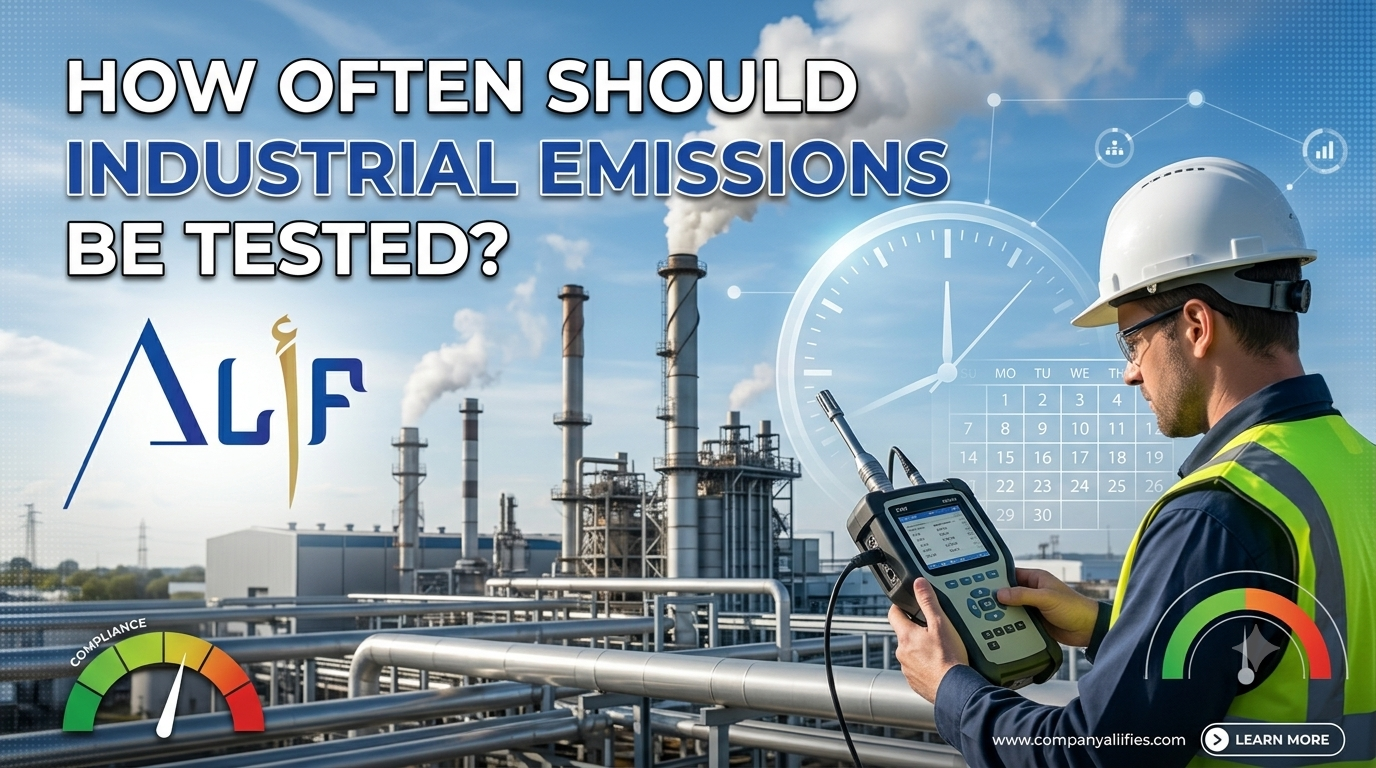
Featured image idea: Environmental testing professionals conducting emissions measurements at an industrial stack.
Publishing note: Avoid publishing a fixed claim such as “industrial emissions must be tested every X months” unless it has been verified against the latest applicable Oman requirements and the specific facility’s permit or environmental approval.

Leave a Reply