


Introduction
Environmental planning is an important part of developing or expanding an industrial facility in Oman.
Before starting certain projects or activities, businesses may need to obtain applicable environmental approvals, permits, or clearances. The documentation required can vary depending on the project type, location, size, industrial activity, environmental risks, and applicable requirements.
Understanding the documentation process early can help facility owners organize their technical information and avoid unnecessary delays.
This guide explains the types of documents that may commonly be relevant to an environmental approval Oman process and how businesses can prepare for environmental assessment and compliance requirements.
Important: The exact documents required are project-specific. Businesses should confirm the current requirements, forms, classifications, submission procedures, and authority requirements applicable to their project before preparing or submitting an application.
What Is Environmental Approval?
Environmental approval is part of the environmental management and regulatory process for certain projects and activities.
Depending on the project, environmental approval may involve reviewing information about:
- Project location
- Industrial activities
- Production processes
- Emission sources
- Waste generation
- Water use
- Wastewater
- Potential environmental impacts
- Pollution-control measures
- Environmental monitoring
The purpose of the documentation is to provide relevant information about the proposed activity and its potential environmental effects.
The exact process and requirements can differ between projects.
Why Are Environmental Approval Documents Important?
Proper documentation gives reviewers a clearer understanding of the proposed project.
1. Explains the Proposed Activity
Project documents describe what the facility will do, what equipment will be used, and how the operation will function.
2. Identifies Environmental Aspects
Documents can help identify potential emissions, waste, wastewater, resource consumption, noise, and other environmental aspects.
3. Supports Environmental Assessment
Technical information may be used to assess potential environmental impacts and determine appropriate mitigation or monitoring measures.
4. Helps Organize Compliance Activities
Maintaining environmental documents from the beginning can make future monitoring, reporting, audits, and inspections easier to manage.
Common Documents for Environmental Approval in Oman
There is no single document checklist that applies to every project.
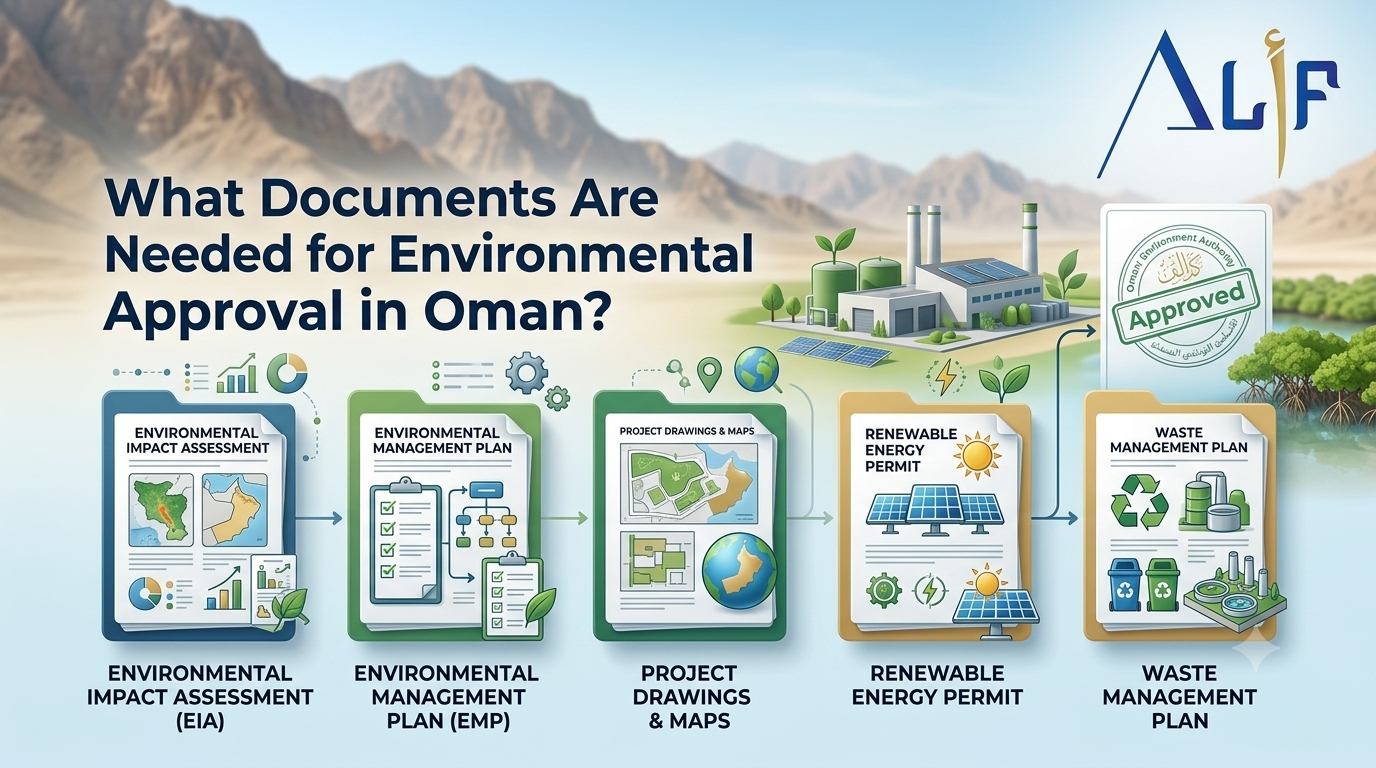
However, businesses may commonly need information or documents from several categories.
1. Project Description
A clear project description is usually an important starting point.
It may include:
- Project name
- Type of industrial activity
- Project objectives
- Proposed production activities
- Production capacity
- Operating schedule
- Construction plans
- Expected operational activities
The project description should be consistent with the technical information provided throughout the application.
2. Site Location and Land Information
Information about the project location may be required.
Depending on the project, this can include:
- Site address or location
- Site coordinates
- Site layout
- Land documents
- Location maps
- Plot information
- Nearby land uses
- Surrounding facilities
Accurate location information is important because environmental considerations can vary based on the project site.
3. Site Layout Plan
A site layout can help show how the proposed facility will be organized.
It may identify:
- Production areas
- Buildings
- Equipment
- Storage areas
- Fuel storage
- Waste storage
- Wastewater systems
- Emission sources
- Access roads
- Utility areas
A clear layout can help reviewers understand the relationship between industrial activities and potential environmental sources.
4. Project Process Description
Industrial projects should clearly explain their production process.
This may include:
- Raw materials
- Production stages
- Equipment
- Chemicals or substances used
- Fuel
- Energy requirements
- Water consumption
- Production output
- Waste generation
A process flow diagram can also be useful where applicable.
5. Environmental Impact Assessment
Depending on the project classification and applicable requirements, an environmental impact assessment Oman may be required.
An EIA can examine potential environmental impacts associated with the proposed project.
Depending on the scope, it may cover:
- Air quality
- Industrial emissions
- Water
- Wastewater
- Soil
- Waste
- Noise
- Ecology
- Resource use
- Other environmental considerations
The exact assessment requirements depend on the project and applicable environmental procedures.
6. Environmental Baseline Data
Baseline information describes existing environmental conditions before or during project development.
Depending on the project, baseline studies may consider:
- Ambient air quality
- Water quality
- Soil
- Noise
- Ecology
- Other environmental parameters
Where testing is required, environmental testing Oman services may provide technical measurements that can support baseline studies.
7. Emissions and Air Quality Information
Industrial facilities may need to provide information about potential air emissions.
This can include:
- Emission sources
- Exhaust stacks
- Boilers
- Generators
- Furnaces
- Process emissions
- Potential pollutants
- Pollution-control systems
Where applicable, emissions testing and air quality monitoring data can support environmental assessment and monitoring activities.
8. Waste Management Information
Projects should consider the waste generated during construction and operation.
Relevant information may include:
- Waste types
- Estimated quantities
- Storage arrangements
- Handling procedures
- Transportation
- Treatment
- Recycling
- Disposal arrangements
Different waste streams may require different management approaches.
9. Water and Wastewater Information
Water-related information can be important for industrial projects.
Documentation may include information about:
- Water sources
- Water consumption
- Production-related water use
- Wastewater generation
- Wastewater treatment
- Discharge arrangements
- Monitoring
The exact requirements depend on the project and applicable environmental conditions.
10. Pollution-Control Measures
Businesses may need to explain how potential environmental impacts will be controlled.
Depending on the facility, measures may include:
- Dust-control systems
- Filters
- Scrubbers
- Wastewater treatment
- Spill-control measures
- Waste management systems
- Noise controls
- Emission-control equipment
The control measures should correspond to the environmental risks identified during project planning.
11. Environmental Monitoring Plan
An environmental monitoring plan explains how environmental performance will be monitored during project operation.
It may identify:
- Parameters
- Monitoring locations
- Testing methods
- Testing frequency
- Responsible personnel
- Record-keeping procedures
- Corrective actions
Monitoring requirements should be based on the facility’s activities and applicable environmental conditions.
12. Emergency and Spill Response Information
Depending on the type of project, environmental documentation may also consider potential emergency situations.
Examples can include:
- Chemical spills
- Fuel spills
- Equipment failures
- Waste leaks
- Uncontrolled emissions
- Other environmental incidents
The project should have appropriate procedures for preventing and responding to relevant environmental incidents.
13. Previous Environmental Records
For an existing facility applying for an expansion, modification, renewal, or other environmental process, previous environmental records may be relevant.
These can include:
- Previous environmental approvals
- Environmental permits
- Monitoring reports
- Emissions test reports
- Environmental audit records
- Corrective-action records
- Previous inspection documentation
Maintaining historical records can help demonstrate how environmental performance has been managed over time.
14. Company and Applicant Information
Administrative information may also be required as part of an environmental application.
Depending on the process, this may include:
- Company information
- Applicant details
- Project owner information
- Contact details
- Authorized representative information
- Commercial or registration documents where applicable
The exact administrative documents should be confirmed before submission.
Environmental Approval Documents for New Projects
New projects may need to prepare environmental information before construction or operation.
A practical preparation sequence can be:
Project planning → Site information → Process description → Environmental assessment → Mitigation measures → Monitoring plan → Supporting documents → Application
Starting early gives the project team time to identify missing information.
Environmental Approval Documents for Existing Facilities
Existing facilities may have a different documentation requirement.
For example, a facility undergoing expansion may need to provide information about:
- Existing operations
- Proposed changes
- Additional production
- New equipment
- New emission sources
- Changes in waste generation
- Changes in water consumption
- Existing environmental performance
The environmental documentation should clearly distinguish existing activities from proposed changes.
How Environmental Testing Supports Approval Documentation
Environmental testing can provide technical information that supports environmental documentation.
Depending on the project, testing may provide information about:
- Air quality
- Industrial emissions
- Water
- Wastewater
- Soil
- Noise
- Other environmental parameters
Reliable testing data can help establish baseline conditions or support ongoing environmental monitoring.
However, testing is only one part of the overall approval process.
Importance of Accurate Environmental Data
Incorrect or incomplete environmental information can make project assessment more difficult.
Businesses should ensure that:
- Project information is current
- Production figures are accurate
- Equipment details are correct
- Emission sources are identified
- Waste streams are documented
- Water requirements are realistic
- Testing results are properly recorded
- Supporting documents are organized
If project details change during development, the relevant documentation should be reviewed and updated as appropriate.
Common Mistakes in Environmental Approval Applications
Submitting Incomplete Documents
Missing information can create additional communication and review requirements.
Using Outdated Information
Old project drawings, production figures, or environmental data may no longer represent the proposed activity.
Not Identifying All Emission Sources
Businesses should review both major and relevant supporting emission sources.
Poor Documentation
Environmental reports and testing results should be stored in an organized manner.
Starting Too Late
Environmental documentation can require coordination between technical, operational, engineering, and management teams.
Starting early provides more time to address missing information.
Assuming Every Project Has the Same Requirements
Different projects can have different environmental characteristics and documentation requirements.
How to Prepare an Environmental Approval Document Checklist
A simple checklist can help businesses organize their preparation.
Project Information
- Project description
- Project location
- Site information
- Site layout
- Production capacity
- Process description
- Equipment list
Environmental Information
- Emission sources
- Potential pollutants
- Air quality information
- Water consumption
- Wastewater
- Waste streams
- Noise sources
- Environmental baseline data
Management Information
- Pollution-control measures
- Environmental monitoring plan
- Waste management plan
- Emergency response procedures
- Corrective-action procedures
Supporting Documents
- Environmental assessment where applicable
- Environmental testing reports
- Previous environmental approvals
- Previous monitoring reports
- Relevant permits
- Company and applicant information
- Other project-specific documents
Environmental Approval in Oman
For businesses planning projects in Oman, environmental approval requirements should be reviewed during the early stages of project development.
The exact process can depend on:
- Project type
- Industrial activity
- Location
- Project size
- Environmental risk
- Emission sources
- Waste generation
- Water requirements
- Applicable environmental classification
- Current regulatory requirements
Businesses should verify the latest requirements and submission procedures applicable to their specific project.
This is especially important because environmental procedures, forms, classifications, and documentation requirements can change over time.
How Alifoman Can Support Environmental Testing
Alifoman can support businesses in Oman with environmental testing and monitoring activities that may contribute technical information to environmental management and project documentation.
Depending on the required scope, environmental testing can support areas such as:
- Industrial emissions testing
- Air quality monitoring
- Environmental monitoring
- Environmental assessments
- Water-related testing
- Technical environmental reporting
The exact scope should be confirmed based on the project’s requirements and applicable environmental conditions.
Frequently Asked Questions
What documents are needed for environmental approval in Oman?
The exact requirements depend on the project. Common categories can include project information, site details, process descriptions, environmental assessments, emissions information, waste and wastewater details, monitoring plans, and supporting administrative documents.
Is an environmental impact assessment required for every project?
Not necessarily. Requirements can vary based on project type, scale, location, activities, environmental risk, and applicable environmental procedures.
What is an environmental permit?
An environmental permit is an approval or authorization associated with applicable environmental requirements for certain activities. The specific process and conditions depend on the activity and current requirements.
Can environmental testing support environmental approval?
Yes. Where applicable, environmental testing can provide technical data related to air, emissions, water, wastewater, soil, noise, and other environmental parameters.
Do existing facilities need environmental documents?
Existing facilities may need environmental documentation for activities such as expansion, modification, renewal, monitoring, or other applicable regulatory processes.
Why is a site layout important?
A site layout helps show the location of buildings, equipment, emission sources, storage areas, waste areas, wastewater systems, and other relevant facility components.
What should an environmental monitoring plan contain?
Depending on the project, it may identify environmental parameters, monitoring locations, testing methods, frequency, responsibilities, record keeping, and corrective actions.
How early should businesses prepare environmental approval documents?
Environmental planning should ideally begin during the early project-development stage so environmental requirements can be considered alongside engineering, construction, and operational planning.
Conclusion
Preparing the right documentation is an important part of the environmental approval Oman process.
Although the exact requirements vary between projects, facility owners should be prepared to provide clear information about their site, industrial processes, equipment, emissions, waste, water use, wastewater, environmental risks, mitigation measures, and monitoring activities.
Environmental testing can provide useful technical information for baseline assessments, environmental monitoring, and supporting documentation where required.
The most effective approach is to start environmental planning early, maintain accurate project information, organize supporting records, and verify the latest requirements before submission.
For industrial businesses in Oman, combining environmental testing Oman, environmental monitoring, impact assessment, and proper documentation can help create a more structured approach to environmental management throughout the project lifecycle.
SEO Implementation Recommendations
Primary keyword: environmental approval Oman
Use naturally in:
- SEO title
- Meta description
- Introduction
- Main H2
- FAQ
- Conclusion
Secondary keywords:
- environmental approval documents Oman
- environmental permit Oman
- environmental compliance Oman
- environmental impact assessment Oman
- environmental testing Oman
- environmental monitoring Oman
- industrial environmental approval
- environmental assessment Oman
Suggested internal links:
- Environmental impact assessment
- Environmental testing lab
- Environmental monitoring
- Air quality compliance
- Industrial emissions testing
- Emissions testing frequency
- Environmental compliance services
Suggested schema:
- Article Schema
- FAQ Schema
- Breadcrumb Schema
Featured image idea: Facility owner or environmental consultant reviewing environmental approval documents and an industrial site plan.
Publishing note: Do not publish a fixed list of “mandatory” documents unless it has been checked against the latest official Oman requirements and the specific project classification. Requirements can vary by project type and approval process.

Leave a Reply